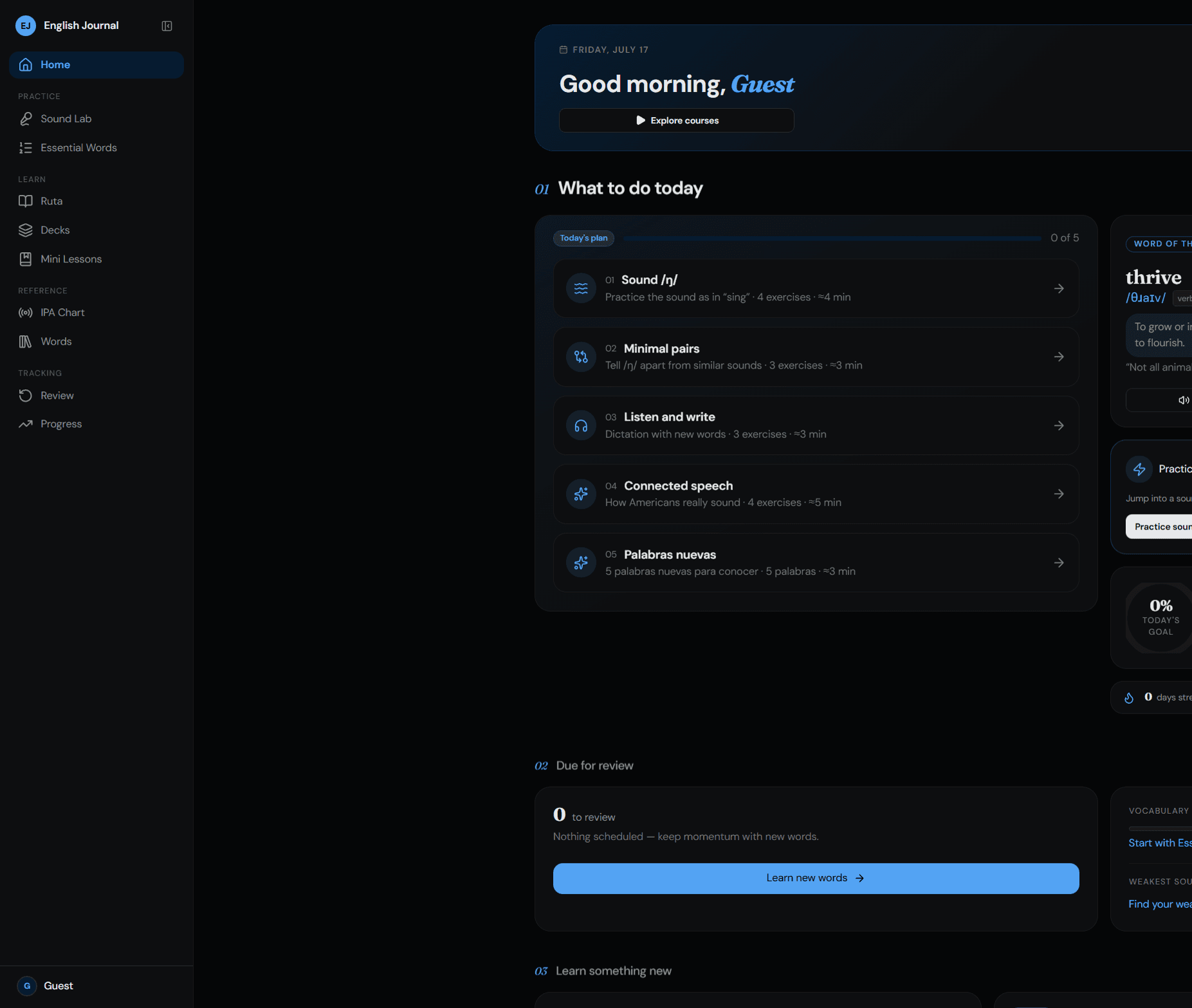
You can read English just fine; now you need people to understand you.
English Journal listens to how you speak, spots the sound you keep missing, and decides what you practice tomorrow. No mascots, no lives, no empty rewards. And it works even offline.
- Disciplines
- UX/UIFrontend
- Role
- Context
- Duration
- Stack
- Enlaces externos
- Try it live
Why build a pronunciation journal instead of another language app?
Most non-native professionals read technical documentation and write emails effortlessly. The friction starts when speaking: the anxiety of wondering whether someone understood your words or which phoneme you just misplaced.
Commercial apps address this by rewarding addiction rather than genuine speech improvement. English Journal started with a clear thesis: practice real-world phonetics in a private space, free of vanity metrics, and accessible anywhere.
Mainstream apps optimize for user retention over communicative clarity
After auditing existing language learning tools, I identified three structural flaws that hinder genuine speaking progress:
The goal was to create an app you can launch anywhere with zero signal, that gives you honest assessments of what you have mastered, and leverages generative AI solely where it adds irreplaceable value.
Apps requiring continuous internet connectivity that become unusable on subways or weak signals.
Local-first architecture via Dexie (IndexedDB): speech logs and voice notes are stored locally.
Addictive streaks and gamified lives that reward opening the app without measuring oral clarity.
FSRS spaced repetition model: retention increases only through evaluated phonetic accuracy.
Sending every vowel to costly cloud models, resulting in slow roundtrips and high server bills.
In-browser Kokoro TTS and deterministic validators; cloud LLMs are reserved for semantic feedback.
A local-first architecture built to practice offline without latency
To ensure instant, reliable interaction regardless of network conditions, I structured the app around four core architectural principles:
Who owns the voice recordings and audio data?
All voice processing happens on-device and stays in local storage by default. Nothing leaves without explicit user consent.
How does it work offline without cloud transcription?
It leverages the browser native Web Speech API and cached client models to keep phonetic feedback instant without signal.
Why avoid traditional gamification badges?
Gamified lives trigger churn anxiety; a deliberate, private environment focused on phonetics fosters sustainable practice.
How is phonetic precision verified?
Audio waveforms and formants are matched directly against native benchmarks with millisecond accuracy.
Four pillars dedicated to a single profile of your voice
The interface is built to fit into everyday routines without cosmetic distractions. Progress is structured into four focused modules:
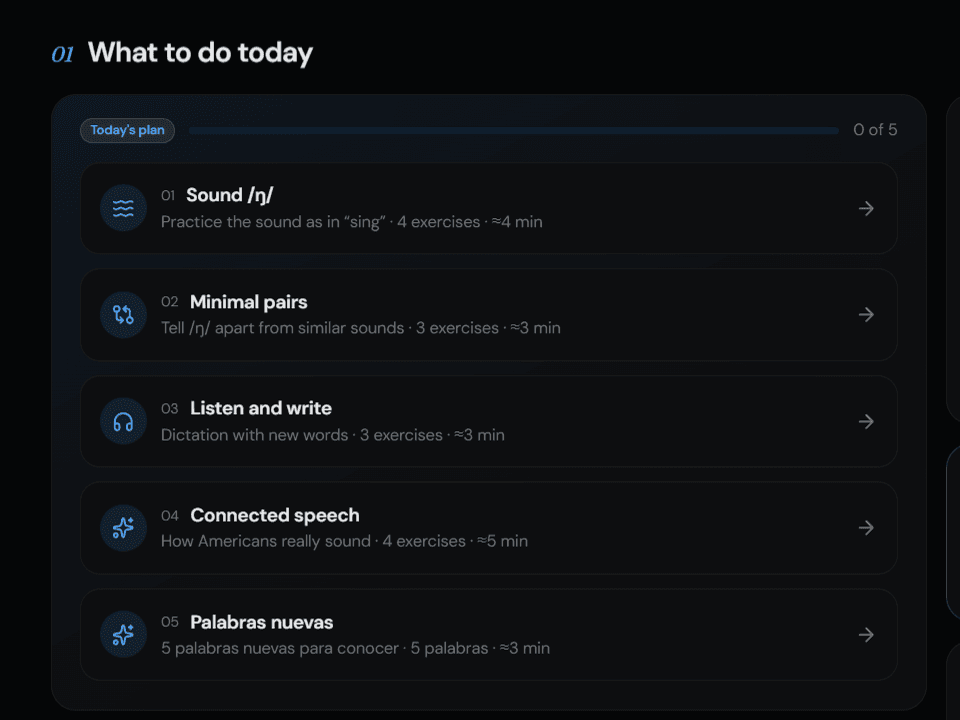
By the numbers and live in production
English Journal is in continuous production and tested against a comprehensive automated test suite verifying everything from repetition scheduling to accessibility standards:
What I learned from this project
Local-first as a sign of respect
Software that respects people’s time works first on their device and only contacts the cloud when strictly necessary.
Disciplined and budgeted AI
Handling what is deterministic with code keeps costs minimal and makes application responses reliable and fast.
Evidence over cosmetic milestones
Reading is exposure, saving is intent, and speaking is evidence. Fluency is earned through evaluated practice, not by accumulating artificial streaks.